
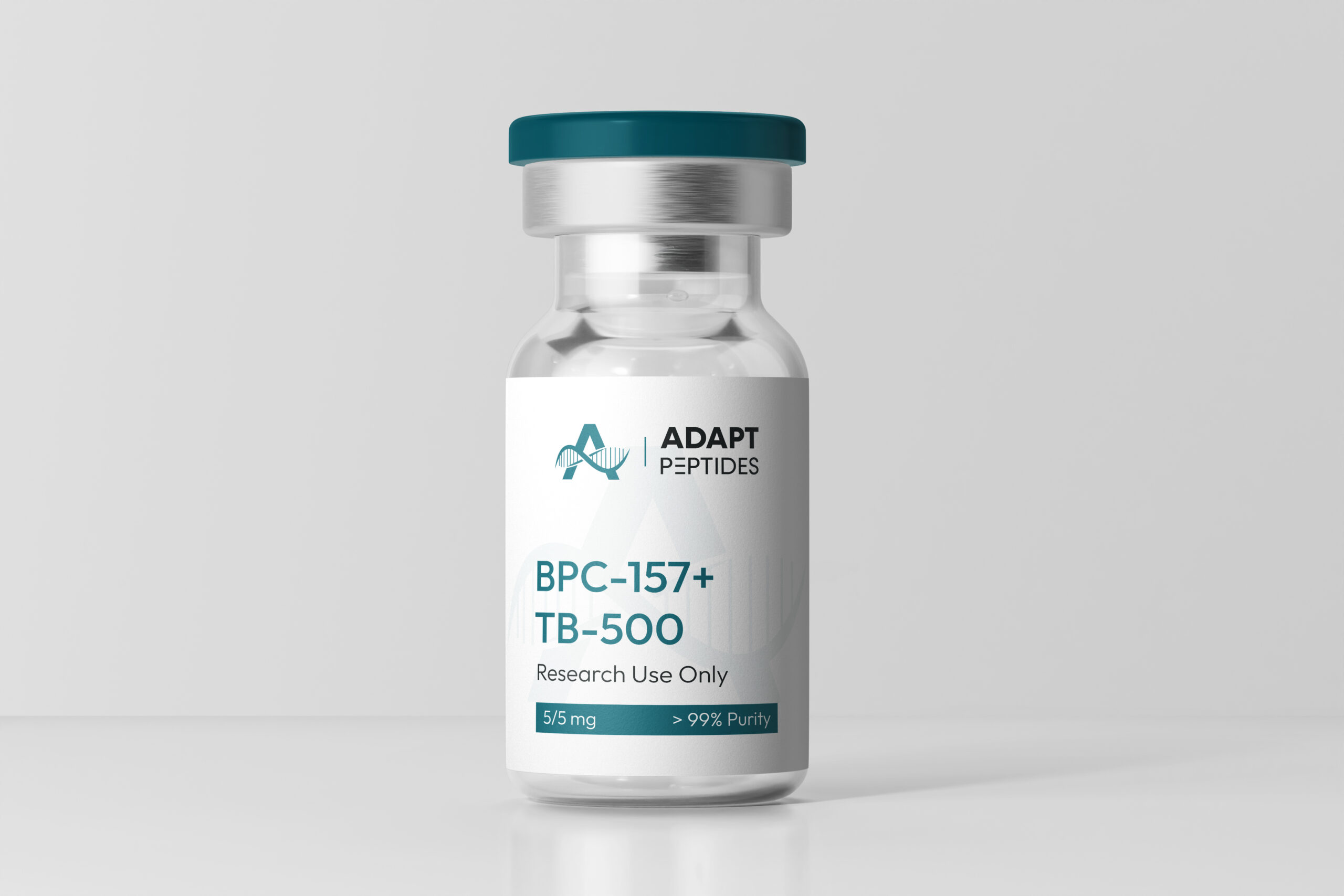
BPC-157 & TB-500 Blend 5/5 mg
$75.00
In stock
| Quantity | Quantity | Price per Vial |
|---|---|---|
| Quantity Based Discount | 2 - 4 | 5% $71.25 |
| Quantity Based Discount | 5 - 9 | 10% $67.50 |
| Quantity Based Discount | 10 - 19 | 15% $63.75 |
| Quantity Based Discount | 20 + | 25% $56.25 |
Ships same-day if ordered before 1 PM EST. Estimated delivery: 2 - 5 days
BPC-TB-10
Description
Chemical Information
Shipping Information
Order BPC-157 + TB-500 peptide blend (AKA the Wolverine stack) from Adapt Peptides, your trusted source for high-purity research compounds. This blend brings together two of the most widely studied research peptides in a single vial containing 5mg BPC-157 and 5mg TB-500.
This blend simplifies co-administration for consistency in experimental design. Adapt Peptides ensures strict quality standards with independent lab testing, CoAs available. Order now for fast, secure shipping backed by reliable customer support. Sold for research use only.
Order BPC-157 + TB-500 peptide blend (5/5mg Wolverine stack) from Adapt Peptides, your trusted source for high-purity research compounds. This blend brings together two of the most widely studied research peptides in a single vial containing 5mg BPC-157 and 5mg TB-500. Blending the peptides simplifies co-administration for consistency in experimental design.
Adapt Peptides ensures strict quality standards with independent lab testing, CoAs available. Order now for fast, secure shipping backed by reliable customer support. Sold for research use only.
Detailed Description
What is BPC-157 + TB-500 (Wolverine Blend)?
The BPC-157 + TB-500 peptide blend, often called the Wolverine stack, is a research peptide combination designed for advanced studies on cellular repair, tissue regeneration, and inflammatory pathways.
The formula unites two well-characterized peptides—BPC-157, a fragment derived from a gastric protein, and TB-500, a synthetic segment modeled after the naturally occurring Thymosin Beta-4 (TB-4).
BPC-157
BPC-157 (Body Protection Compound-157) is a synthetic peptide consisting of 15 amino acids that has been widely studied in animal and in vitro models. Research findings suggest that it plays roles in angiogenesis (the growth of new blood vessels), fibroblast activity (cells involved in tissue repair), and the healing of tendons and ligaments[1].
It has also demonstrated protective effects in the gastrointestinal tract and nervous system. Because it is unusually stable in plasma and dissolves easily in solution, it is frequently chosen for studies focused on regeneration and recovery.
In short, BPC-157 is a “repair-supporting peptide,” according to research findings. In preclinical models, it has shown the ability to speed up the healing of injuries, protect the stomach lining, and even support recovery in nerve-related damage. When paired with TB-500, this healing and repair effect may be multiplied, hence the name “Wolverine stack.”.
TB-500
TB-500 is a synthetic peptide fragment modeled on the active region of Thymosin Beta-4 (TB-4), a naturally occurring 43–amino acid peptide involved in wound healing and cellular repair.
Unlike the full-length TB-4, TB-500 offers greater stability, a longer half-life, and improved shelf life, making it more practical for laboratory use. Research has shown TB-500 to promote cell migration, angiogenesis (new blood vessel formation), and muscle fiber regeneration, which makes it a frequent subject in studies of soft tissue injury, cardiac repair, and systemic recovery[2].
TB-500 is more of a “lab-ready version” of TB-4, designed to keep its healing power while being easier to work with in research. Since it may help cells move to injured areas faster, improve blood flow through new vessel growth, and support muscle repair after damage, it’s the perfect companion to BPC-157 for healing and recovery.
TB-4 vs. TB-500 Comparison
Thymosin Beta-4 (TB-4) is a naturally occurring 43–amino acid peptide involved in processes like wound healing, inflammation regulation, and angiogenesis. Despite its biological importance, TB-4’s fragility, high production cost, and limited stability reduce its practical use in experimental settings.
TB-500, in contrast, is a stable, synthetic fragment that retains the key activity-driving region of TB-4. Researchers favor TB-500 for its improved half-life, durability during storage, and compatibility with other peptide protocols, including BPC-157.
Using BPC-157 + TB-500 in Research
BPC-157 and TB-500 are often combined in research because of their overlapping yet complementary mechanisms. Both peptides follow similar cycle lengths and dosing schedules in preclinical studies, making a pre-formulated blend like Wolverine convenient for co-administration.
This combination enables researchers to explore potential synergistic outcomes in tissue repair, inflammation control, vascular growth, and systemic recovery—without the challenges of preparing and coordinating separate compounds.
The Wolverine blend provides a practical platform for investigating how BPC-157 and TB-500 may work together to accelerate healing and regeneration across diverse tissue types.
Note: Research use only. This product is intended strictly for laboratory research. It is not approved for human or veterinary use, therapeutic applications, or diagnostic procedures.
Mechanism of Action (Based on Research)
The BPC-157 + TB-500 blend has gained attention in preclinical research because of its complementary roles in tissue repair, cellular regeneration, and inflammation control.
While neither peptide is approved for therapeutic use, animal and in vitro studies provide insight into how they may operate at a biological level.
Tissue Repair and Cellular Regeneration
BPC-157, a stable 15–amino acid gastric peptide, has been shown in rodent and cell-based studies to accelerate healing of muscle, tendon, ligament, and nerve tissue. It appears to enhance angiogenesis, fibroblast activation, and extracellular matrix remodeling, processes that are central to structural repair[3].
Some studies also suggest that BPC-157 may interact with growth factor pathways, influencing VEGF and other mediators that guide tissue recovery[4].
On the other hand, TB-500, a synthetic fragment of Thymosin Beta-4, primarily exerts its effects through actin regulation, a process that governs how cells migrate and differentiate during wound healing[5].
In research models, TB-500 has been linked to increased vascular endothelial growth factor (VEGF) activity, improved angiogenesis, and facilitation of muscle fiber regeneration[5]. These properties have made it particularly relevant in studies of muscle damage and cardiovascular injury.
Anti-Inflammatory Pathways
Both BPC-157 and TB-500 demonstrate anti-inflammatory activity in preclinical systems. Research suggests they may lower pro-inflammatory cytokine levels, reduce oxidative stress, and help restore balance in tissues under inflammatory strain.
BPC-157, in particular, has been noted for its protective role against NSAID-induced gastric lesions and for possible interaction with nitric oxide signaling, which supports vascular stability[6][7].
In summary, while BPC-157 and TB-500 act on distinct but overlapping biological pathways, their combined use in preclinical settings has been proposed as a way to explore potential synergy in tissue regeneration and inflammation modulation.
These observations are based on animal and cell-based research. The Wolverine blend is strictly intended for laboratory study and is not approved for human or veterinary use.
Research Applications (Wolverine Blend Benefits)
Although BPC-157 and TB-500 remain in the preclinical stage and are not approved for human use, a growing body of laboratory research has investigated their roles in tissue repair, inflammation control, and recovery models.
By combining the two into a single formulation, the Wolverine blend allows researchers to study multi-pathway regenerative processes with simplified co-administration.
Musculoskeletal and Soft Tissue Research
Animal studies suggest that BPC-157 may aid the healing of muscles, tendons, ligaments, and nerves by stimulating angiogenesis, promoting fibroblast migration, and reducing oxidative stress[8].
For example, one study investigated tendon healing in rats and found that BPC-157 significantly accelerated tendon fibroblast outgrowth, improved survival under oxidative stress, and increased fibroblast migration in a dose-dependent manner[9].
TB-500 complements these findings by supporting myogenesis, muscle fiber regeneration, and wound healing. Its ability to regulate actin polymerization and increase VEGF expression makes it a frequent subject in muscle injury and cardiovascular research models[10].
Inflammatory Modulation
Both peptides have demonstrated the capacity to reduce inflammation in rodent studies.
For example, one study found that BPC-157 protected rats from diclofenac-induced toxicity, significantly reducing gastrointestinal, liver, and brain lesions[11]. This suggests a potential role in protecting against NSAID-induced organ damage.
In another study, a synthetic fragment of Thymosin Beta-4, TB-500 has been studied for its ability to modulate macrophage activity, regulate immune cell migration, and promote actin remodeling—all of which are critical in immune and wound-healing responses[12].
Post-Injury Recovery Studies
Because their mechanisms overlap but are not identical, BPC-157 and TB-500 are often studied together in systemic injury recovery models. Preclinical studies have explored their combined use in contexts such as soft tissue trauma, post-surgical healing, and overuse injury recovery.
While more controlled research is needed, current evidence suggests their combined administration may accelerate repair and help restore tissue balance.
Please note that all these findings are based on animal and cell-based studies. This product is intended for laboratory research only and is not approved for human or veterinary use.
Wolverine Peptide Characteristics (BPC-157 + TB-500)
The Wolverine blend is a dual-peptide formulation combining BPC-157 and TB-500, designed specifically for laboratory research. By pairing these peptides into one vial, researchers gain a more convenient tool for investigating tissue repair, inflammatory modulation, vascular growth, and post-injury recovery pathways.
BPC-157 & TB-500 Blend Characteristics
BPC-157
- Molecular Formula: C₆₂H₉₈N₁₆O₂₂
- CAS Number: 137525-51-0
- Amino Acid Sequence: Gly-Glu-Pro-Pro-Pro-Gly-Lys-Pro-Ala-Asp-Asp-Ala-Gly-Leu-Val
- Synonyms: Body Protection Compound-157
- Molar Mass: 1,419.5355 g/mol
TB-500
- Molecular Formula: C₃₈H₆₈N₁₀O₁₄ (may vary by synthesis route)
- CAS Number: 885340-08-9 (free base)
- Amino Acid Sequence:
- Ac-Ser-Asp-Lys-Pro-Asp-Met-Ala-Glu-Ile-Glu-Lys-Phe-Asp-Lys-Ser-Lys-Leu-Lys-Lys-Thr-Glu-Thr-Gln-Glu-Lys-Asn-Pro-Leu-Glu-Glu-Ala-Glu-Asp-Leu-Asn-Glu-Glu-Glu-Lys-Glu-Ala-Gly-Glu-Ser
- Synonyms: Thymosin Beta-4 Fragment (TB-500)
- Molar Mass: ~889.02 g/mol (manufacturing dependent)
- Wolverine Storage Recommendations
- Before reconstitution: Keep lyophilized vials refrigerated at 36–46 °F (2–8 °C), in a dry, light-protected environment.
- After reconstitution: Store at 36–46 °F (2–8 °C) and use within 14–28 days. Reconstitute using bacteriostatic water for optimal stability.
Wolverine vs BPC-157 vs TB-500 vs Thymosin Alpha-1 Comparison
Feature | BPC-157 + TB-500 (Wolverine) | BPC-157 Alone | TB-500 Alone | Thymosin Alpha-1 (Tα1) |
Type | Peptide blend (regenerative peptides) | Single peptide (gut protection, tissue repair) | Single peptide (actin regulation, tissue regeneration) | Single peptide (immune modulation) |
Primary Research Targets | Tissue repair, inflammation modulation, angiogenesis | Tissue healing, anti-inflammatory, gut protection | Wound healing, cell migration, angiogenesis | Immune response, inflammation control |
Mechanism Complexity | Multi-pathway synergy (fibroblast activity + actin regulation + vascular support) | Focused on fibroblast and endothelial cell activity | Focused on actin cytoskeleton remodeling and migration | Modulation of T-cells, dendritic cells, and cytokine balance |
Research Stage | Preclinical / early clinical interest | Preclinical and some clinical exploration | Primarily preclinical | Preclinical and multiple clinical trials |
Observed Benefits (Preclinical Research) | Enhanced soft tissue healing, anti-inflammatory effects, vascular support | Faster repair of muscles, tendons, ligaments | Improved wound closure, cell motility, angiogenesis | Strengthened immune signaling, reduced inflammation |
Dosing Frequency | Typically cyclic, 2–4 weeks | Often daily or twice daily in cycles | Cyclic, similar to BPC-157 | Varies, often several subcutaneous doses per week |
Approval Status | Research use only | Research use only | Research use only | Research use only / Investigational clinical applications |
Disclaimer | For research only, not for human use | For research only, not for human use | For research only, not for human use | For research only, not approved for human use |
Safety and Side Effects in Studies
Most of the available data on BPC-157, TB-500, and their combined use (Wolverine blend) comes from preclinical animal models and in vitro systems. Across these studies, the peptides have generally shown favorable tolerability profiles when administered at research-appropriate dosages.
BPC-157 Safety
Animal studies have not reported significant systemic toxicity, even with prolonged administration. Research has suggested protective effects against gastric lesions, liver injury, and systemic toxicity induced by NSAIDs, with no apparent adverse impact on organ function at studied levels[11][13].
TB-500 Safety
Preclinical data indicates low toxicity, with observations primarily focused on enhanced tissue regeneration and wound repair. No dose-limiting toxicities have been identified in animal models to date[12].
For the combined blend, there’s limited preclinical reports suggesting additive or complementary effects in tissue healing and inflammation control. Similarly, there are currently no comprehensive toxicological evaluations of the combined formulation.
As such, the Wolverine blend remains strictly a research-only compound.
Certificate of Analysis (COA)
Every vial of Wolverine blend from Evolve Peptides undergoes independent third-party laboratory testing to confirm identity, purity, and molecular integrity. Certificates of Analysis (COAs) are made available to researchers for transparency and reproducibility:
- Purity Verification: Typically exceeding 99% by HPLC or mass spectrometry.
- Identity Confirmation: Verified through peptide mapping and sequencing.
- Batch-Specific Documentation: COAs can be requested with any order or downloaded where available.
This commitment to quality control ensures that researchers can rely on consistent and verifiable data in experimental applications.
Legal Disclaimer
This product is intended for laboratory research purposes only. It is not approved for human or veterinary consumption, therapeutic use, or diagnostic procedures. Evolve Peptides does not make any claims regarding efficacy, safety, or medical application.
By purchasing this product, researchers acknowledge responsibility for its safe handling, storage, and use in accordance with applicable regulations.
Scientific References
- Huang T, Zhang K, Sun L, Xue X, Zhang C, Shu Z, Mu N, Gu J, Zhang W, Wang Y, Zhang Y, Zhang W. Body protective compound-157 enhances alkali-burn wound healing in vivo and promotes proliferation, migration, and angiogenesis in vitro. Drug Des Devel Ther. 2015 Apr 30;9:2485-99. https://pmc.ncbi.nlm.nih.gov/articles/PMC4425239/
- D. Philp, A.L. Goldstein, H.K. Kleinman,
Thymosin β4 promotes angiogenesis, wound healing, and hair follicle development, Mechanisms of Ageing and Development, Volume 125, Issue 2, 2004, Pages 113-115.
https://www.sciencedirect.com/science/article/abs/pii/S0047637403002252?via%3Dihub
- Japjec M, Horvat Pavlov K, Petrovic A, Staresinic M, Sebecic B, Buljan M, Vranes H, Giljanovic A, Drmic D, Japjec M, Prtoric A, Lovric E, Batelja Vuletic L, Dobric I, Boban Blagaic A, Skrtic A, Seiwerth S, Predrag S. Stable Gastric Pentadecapeptide BPC 157 as a Therapy for the Disable Myotendinous Junctions in Rats. Biomedicines. 2021 Oct 27;9(11):1547.
https://pmc.ncbi.nlm.nih.gov/articles/PMC8615275/
- Seiwerth S, Milavic M, Vukojevic J, Gojkovic S, Krezic I, Vuletic LB, Pavlov KH, Petrovic A, Sikiric S, Vranes H, Prtoric A, Zizek H, Durasin T, Dobric I, Staresinic M, Strbe S, Knezevic M, Sola M, Kokot A, Sever M, Lovric E, Skrtic A, Blagaic AB, Sikiric P. Stable Gastric Pentadecapeptide BPC 157 and Wound Healing. Front Pharmacol. 2021 Jun 29;12:627533.
https://pmc.ncbi.nlm.nih.gov/articles/PMC8275860/
- Goldstein AL, Hannappel E, Sosne G, Kleinman HK. Thymosin β4: a multi-functional regenerative peptide. Basic properties and clinical applications. Expert Opin Biol Ther. 2012 Jan;12(1):37-51.
https://pubmed.ncbi.nlm.nih.gov/22074294/
- Józwiak, M., Bauer, M., Kamysz, W., & Kleczkowska, P. (2025). Multifunctionality and Possible Medical Application of the BPC 157 Peptide—Literature and Patent Review. Pharmaceuticals, 18(2), 185.
https://www.mdpi.com/1424-8247/18/2/185
- Sikiric P, Hahm KB, Blagaic AB, Tvrdeic A, Pavlov KH, Petrovic A, Kokot A, Gojkovic S, Krezic I, Drmic D, Rucman R, Seiwerth S. Stable Gastric Pentadecapeptide BPC 157, Robert’s Stomach Cytoprotection/Adaptive Cytoprotection/Organoprotection, and Selye’s Stress Coping Response: Progress, Achievements, and the Future. Gut Liver. 2020 Mar 15;14(2):153-167.
https://pmc.ncbi.nlm.nih.gov/articles/PMC7096228/
- Vukojevic J, Milavić M, Perović D, Ilić S, Čilić AZ, Đuran N, Štrbe S, Zoričić Z, Filipčić I, Brečić P, Seiverth S, Sikirić P. Pentadecapeptide BPC 157 and the central nervous system. Neural Regen Res. 2022 Mar;17(3):482-487.
https://pmc.ncbi.nlm.nih.gov/articles/PMC8504390/
- Chang CH, Tsai WC, Lin MS, Hsu YH, Pang JH. The promoting effect of pentadecapeptide BPC 157 on tendon healing involves tendon outgrowth, cell survival, and cell migration. J Appl Physiol (1985). 2011 Mar;110(3):774-80.
https://pubmed.ncbi.nlm.nih.gov/21030672/
- Tokura Y, Nakayama Y, Fukada S, Nara N, Yamamoto H, Matsuda R, Hara T. Muscle injury-induced thymosin β4 acts as a chemoattractant for myoblasts. J Biochem. 2011 Jan;149(1):43-8.
https://pubmed.ncbi.nlm.nih.gov/20880960/
- Spomenko Ilic, Domagoj Drmic, Sandra Franjic, Danijela Kolenc, Marijana Coric, Luka Brcic, Robert Klicek, Bozo Radic, Marko Sever, Viktor Djuzel, Marinko Filipovic, Zeljko Djakovic, Vasilije Stambolija, Alenka Boban Blagaic, Ivan Zoricic, Miroslav Gjurasin, Mirjana Stupnisek, Zeljko Romic, Kamelija Zarkovic, Senka Dzidic, Sven Seiwerth, Predrag Sikiric,
Pentadecapeptide BPC 157 and its effects on a NSAID toxicity model: Diclofenac-induced gastrointestinal, liver, and encephalopathy lesions, Life Sciences, Volume 88, Issues 11–12, 2011, Pages 535-542, ISSN 0024-3205.
https://www.sciencedirect.com/science/article/abs/pii/S002432051100035X
- Maar K, Hetenyi R, Maar S, Faskerti G, Hanna D, Lippai B, Takatsy A, Bock-Marquette I. Utilizing Developmentally Essential Secreted Peptides Such as Thymosin Beta-4 to Remind the Adult Organs of Their Embryonic State-New Directions in Anti-Aging Regenerative Therapies. Cells. 2021 May 28;10(6):1343.
https://pmc.ncbi.nlm.nih.gov/articles/PMC8228050/
- Józwiak, M., Bauer, M., Kamysz, W., & Kleczkowska, P. (2025). Multifunctionality and Possible Medical Application of the BPC 157 Peptide—Literature and Patent Review. Pharmaceuticals, 18(2), 185.
Contents: 10 mg lyophilized (freeze-dried) powder provided in a 3 ml vial, sealed and sterile. Purity exceeds 99%, guaranteed.
Notes:Â Requires reconstitution with bacteriostatic water. (Sold Here:Â BAC Water.)
Chemical Formula:
BPC-157: C62H98N16O22
TB-500: C212H350N56O78S
PubChem CID:
BPC-157: 108101
TB-500: 16132341
CAS Number:
BPC-157: 137525-51-0
TB-500: 77591-33-4
Molecular Weight:
BPC-157: 1419.6 g/mol
TB-500: 4963.44 g/mol
Storage: Store at ≤8°C, sealed, away from heat, light, and moisture. The colder the better.
Overall Purity:Â >99%
Orders placed before 1 PM EST ship same day.
We use USPS for most of our deliveries. You can expect your parcel within 2-5 business days from when it leaves our warehouse.
Why Choose Us?
Potency & Purity Guaranteed
Our peptides are custom-manufactured to exact specifications. Strictly no compromises.
Rigorously Third-Party Tested
Every product page includes independent lab test results for every peptide we sell.
Dedicated End-to-End Support
We're here for you every step of the way. Our goal is your success in research.
100% Satisfaction Guaranteed
If you are not 100% satisfied with our research peptides, we'll refund everything you paid.


